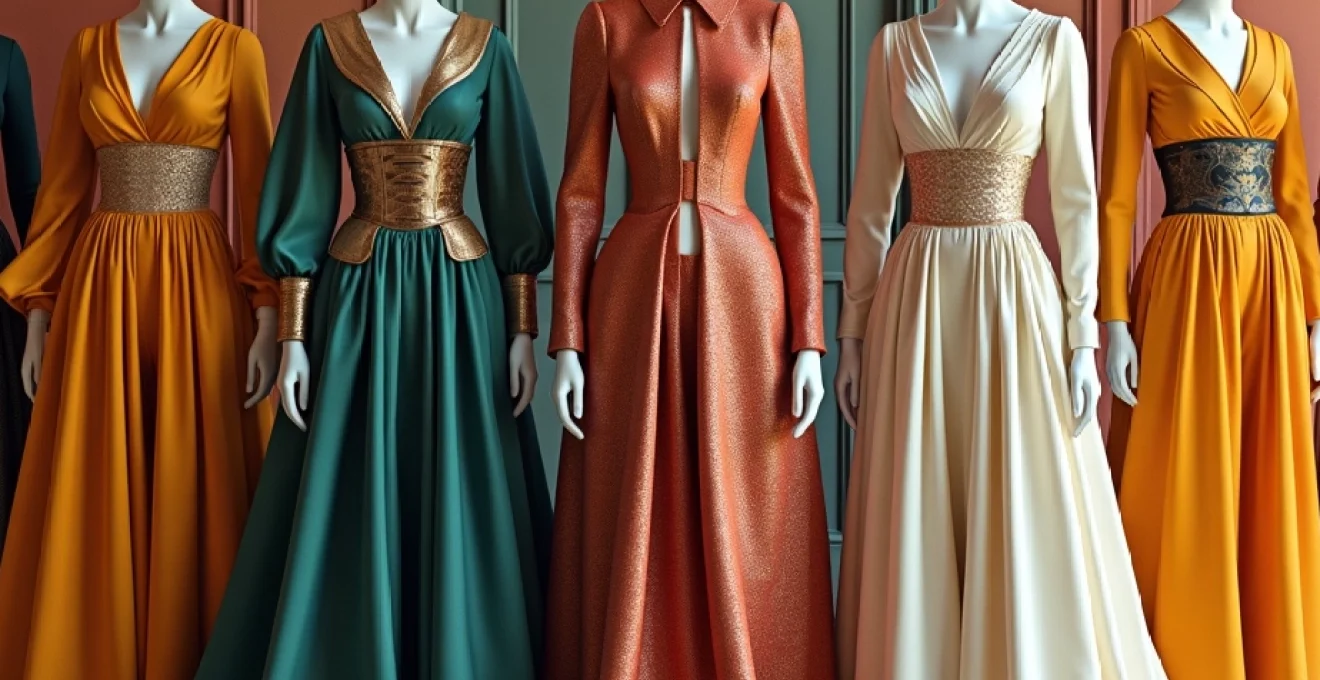
The cyclical nature of fashion has never been more evident than in today’s design landscape, where contemporary creators consistently draw inspiration from bygone eras to craft tomorrow’s trends. From Victorian silhouettes gracing modern runways to Art Deco patterns adorning luxury accessories, the influence of vintage fashion permeates every aspect of contemporary design. This enduring relationship between past and present extends beyond mere aesthetic appreciation, encompassing technical innovation, sustainable practices, and cultural commentary that defines modern fashion discourse.
The resurgence of vintage-inspired design reflects a sophisticated understanding of fashion history combined with contemporary sensibilities. Designers today possess unprecedented access to historical archives, museum collections, and digital repositories that provide detailed insights into construction techniques, fabric choices, and styling approaches from previous decades. This wealth of information enables them to reinterpret classic elements with modern technology and contemporary fit requirements, creating pieces that honour historical craftsmanship while meeting today’s lifestyle demands.
Victorian era silhouettes in contemporary haute couture collections
The Victorian era’s emphasis on structured silhouettes and dramatic proportions continues to captivate contemporary haute couture designers, who skilfully translate nineteenth-century construction principles into modern masterpieces. The intricate relationship between form and function that characterised Victorian garments provides a rich foundation for today’s couturiers, who appreciate the era’s commitment to architectural precision and feminine enhancement through expert tailoring techniques.
Bustle revival techniques in vivienne westwood’s draping methods
Vivienne Westwood’s revolutionary approach to draping draws heavily from Victorian bustle construction, transforming historical techniques into contemporary statements of rebellion and elegance. Her interpretation of bustle architecture involves creating volume through strategic fabric manipulation rather than traditional cage structures, resulting in garments that maintain the era’s dramatic silhouette whilst offering modern wearability. This approach demonstrates how historical construction methods can be adapted using contemporary materials and techniques to achieve similar aesthetic goals.
The technical aspects of Westwood’s bustle revival involve sophisticated pattern engineering that distributes fabric weight evenly across the garment’s structure. By studying original Victorian construction drawings and museum pieces, her design team has developed innovative draping techniques that create the illusion of traditional bustle volume using lightweight fabrics and strategic seaming. This methodology represents a perfect synthesis of historical inspiration and modern practicality.
Corsetry construction principles in alexander McQueen’s structured bodices
Alexander McQueen’s posthumous collections continue to showcase masterful integration of Victorian corsetry principles into contemporary structured bodices that redefine feminine power dressing. The brand’s approach to corset construction involves deconstructing traditional boning techniques and reimagining them using modern materials such as carbon fibre stays and laser-cut leather panels. This evolution maintains the supportive and shape-enhancing qualities of Victorian corsetry whilst eliminating the restrictive aspects that modern wearers would find uncomfortable.
The technical innovation extends to the integration of contemporary fastening systems that provide the security and adjustability of traditional lacing whilst offering the convenience expected in luxury ready-to-wear pieces. McQueen’s design team employs three-dimensional body scanning technology to ensure perfect fit whilst maintaining the dramatic waist emphasis that characterised Victorian silhouettes.
High-neck collar interpretations from erdem’s historical references
Erdem Moralioglu’s consistent use of high-neck collar details demonstrates sophisticated understanding of Victorian neckline construction and its psychological impact on garment perception. His interpretation of period-appropriate collar styles involves adapting traditional construction techniques to accommodate contemporary neckline preferences whilst maintaining the era’s sense of modesty and refinement. The designer’s approach involves studying museum pieces to understand the relationship between collar height, fabric choice, and overall garment proportions.
The technical execution of these high-neck details requires expert pattern manipulation to ensure comfort and movement whilst achieving the desired aesthetic impact. Erdem’s team employs modern interfacing materials and construction techniques to create collars that maintain their shape without the stiffness associated with historical examples, demonstrating how contemporary technology can enhance traditional design elements.
Crinoline-inspired volume creation in simone rocha’s contemporary pieces
Simone Rocha’s masterful use of crinoline-inspired volume represents a sophisticated approach to historical silhouette interpretation that maintains period authenticity whilst embracing contemporary femininity. Her technique involves creating structured underpinnings using modern materials such as horsehair canvas and synthetic boning to achieve the dramatic bell-shaped silhouettes characteristic of Victorian evening wear. This approach allows for the creation of historically accurate proportions without the weight and discomfort associated with traditional steel hoops.
The designer’s understanding of crinoline construction principles extends to strategic fabric selection, with preference given to materials that enhance the desired silhouette whilst providing appropriate drape and movement. Rocha’s interpretation demonstrates how historical construction techniques can be enhanced through contemporary material science to create garments that capture period authenticity whilst meeting modern comfort standards.
Art deco pattern translation through digital textile design
The geometric precision and luxurious aesthetic of Art Deco design continues to influence contemporary textile development, with modern designers employing digital technology to reinterpret 1920s motifs with unprecedented accuracy and innovation. The translation of Art Deco patterns through digital design processes allows for precise colour matching, scale adjustment, and pattern repeat calculations that would have been impossible during the original era, resulting in textiles that surpass their historical inspirations in technical execution whilst maintaining authentic aesthetic appeal.
Digital textile design has revolutionised the way designers approach historical pattern interpretation, enabling precise reproduction of complex Art Deco geometries whilst allowing for contemporary colour palette integration and scale modifications that enhance wearability.
Geometric motif digitisation in prada’s jacquard weaving techniques
Prada’s approach to Art Deco geometric motif interpretation involves sophisticated digital translation of period patterns into contemporary jacquard weaving programmes that achieve remarkable precision in pattern reproduction. The brand’s technical team employs advanced scanning technology to capture the exact proportions and colour relationships of original Art Deco textiles, then adapts these patterns for modern jacquard looms that can achieve thread counts and colour accuracy impossible during the 1920s.
The technical process involves creating digital files that control individual warp and weft threads to recreate the subtle colour gradations and geometric precision characteristic of period Art Deco textiles. This approach allows Prada to produce fabrics that maintain historical authenticity whilst incorporating contemporary fibres and finishing techniques that enhance durability and performance characteristics.
Metallic thread integration methods from 1920s beadwork revival
The revival of 1920s beadwork techniques in contemporary fashion involves sophisticated adaptation of period embellishment methods using modern metallic threads and application technologies. Contemporary designers study museum examples to understand the relationship between bead placement, thread tension, and overall design impact, then employ modern materials and techniques to achieve similar effects with enhanced durability and reduced labour requirements.
Modern metallic thread integration involves the use of advanced synthetic materials that provide the lustre and reflective qualities of period beadwork whilst offering superior colour fastness and washability. This technical evolution allows designers to create garments that capture the glamour of 1920s evening wear whilst meeting contemporary care and durability standards.
Chevron pattern adaptation in saint laurent’s Ready-to-Wear collections
Saint Laurent’s interpretation of Art Deco chevron patterns demonstrates masterful understanding of how geometric motifs can be adapted to enhance contemporary garment construction. The brand’s approach involves scaling traditional chevron patterns to complement modern silhouettes whilst maintaining the dynamic visual impact that made these patterns popular during the Jazz Age. This adaptation requires careful consideration of pattern placement, colour contrast, and fabric choice to ensure optimal aesthetic effect.
The technical execution involves precise pattern matching at seam lines and careful calculation of pattern repeat to ensure visual continuity across garment pieces. Saint Laurent’s design team employs digital pattern planning software to visualise how chevron motifs will appear on three-dimensional garment forms, ensuring that the final product maintains the geometric precision essential to Art Deco aesthetics.
Egyptian revival elements in dolce & gabbana’s embellishment strategies
Dolce & Gabbana’s incorporation of Egyptian Revival elements reflects the Art Deco era’s fascination with ancient Egyptian motifs, translated through contemporary embellishment techniques that achieve remarkable historical accuracy whilst meeting modern production requirements. The brand’s approach involves detailed study of period jewellery, decorative arts, and textile examples to understand the symbolic significance and aesthetic principles underlying Egyptian-inspired Art Deco design.
The technical execution involves combining traditional embroidery techniques with modern materials such as synthetic threads, crystals, and metal alloys that provide the visual impact of period examples whilst offering enhanced durability and colour stability. This approach demonstrates how historical decorative traditions can be enhanced through contemporary material science and production techniques.
1960s mod movement influence on minimalist fashion architecture
The architectural approach to garment construction that characterised the 1960s Mod movement continues to influence contemporary minimalist fashion design, with modern creators drawing inspiration from the era’s emphasis on geometric silhouettes, bold colour blocking, and innovative fabric combinations. The Mod movement’s rejection of traditional feminine silhouettes in favour of streamlined, youth-oriented designs established principles that remain relevant in today’s fashion landscape, where simplicity and functionality are increasingly valued over ornate embellishment.
Contemporary designers appreciate the Mod movement’s sophisticated understanding of colour theory, proportion, and textile innovation, elements that translate seamlessly into modern minimalist collections. The era’s designers pioneered the use of synthetic fabrics and bold colour combinations that challenged traditional fashion conventions, creating a template for contemporary designers who seek to balance aesthetic innovation with wearability and commercial appeal. This influence extends beyond surface aesthetics to encompass fundamental approaches to pattern making, fitting, and garment construction.
The technical innovations of 1960s fashion, particularly the development of A-line silhouettes and shift dresses, provided blueprints for contemporary minimalist design that emphasise clean lines and architectural precision. Modern designers study period construction techniques to understand how geometric shapes can be translated into three-dimensional garments that enhance the wearer’s natural form without relying on traditional methods of waist emphasis or bust enhancement. This approach requires sophisticated pattern engineering and an understanding of fabric behaviour that builds upon Mod-era innovations.
The sustainable aspects of Mod-inspired minimalist design align with contemporary concerns about fashion’s environmental impact. The movement’s emphasis on quality construction, timeless silhouettes, and versatile pieces that can be styled multiple ways provides a framework for creating capsule wardrobes that resist seasonal trend pressures. This approach demonstrates how historical design principles can inform contemporary sustainable fashion practices whilst maintaining aesthetic relevance and commercial viability.
Sustainable vintage sourcing networks for contemporary design studios
The development of sophisticated vintage sourcing networks has become essential for contemporary design studios seeking to incorporate authentic historical elements into their collections whilst maintaining ethical and sustainable practices. These networks encompass everything from deadstock fabric procurement to vintage hardware authentication, creating a complex ecosystem that supports both historical preservation and contemporary innovation. The growth of these networks reflects increasing industry recognition that vintage materials often offer superior quality and unique aesthetic qualities compared to modern equivalents.
Sustainable vintage sourcing represents a paradigm shift in fashion production, where historical materials become the foundation for contemporary innovation rather than mere inspiration, creating a circular economy that values both craftsmanship heritage and environmental responsibility.
Deadstock fabric procurement from Post-War textile archives
The procurement of deadstock fabrics from post-war textile archives has emerged as a crucial sustainability strategy for luxury fashion houses seeking to reduce their environmental impact whilst accessing superior quality materials. These archives contain fabrics manufactured during periods when textile production emphasised durability and craftsmanship over cost efficiency, resulting in materials that often surpass contemporary equivalents in terms of fibre quality, weave construction, and colour fastness.
The technical challenges of working with archived deadstock fabrics include assessing fabric condition, testing for colour stability, and determining appropriate care requirements for garments incorporating these materials. Design studios employ textile conservators and technical experts to evaluate vintage fabrics, ensuring that they meet contemporary quality standards whilst preserving their historical integrity. This process requires sophisticated understanding of fabric degradation patterns and preservation techniques.
Zero-waste pattern engineering using historical cutting techniques
Zero-waste pattern engineering inspired by historical cutting techniques represents an innovative approach to sustainable fashion design that minimises fabric waste whilst creating garments with authentic period proportions. Historical cutting methods, developed during eras when fabric was expensive and waste was economically prohibitive, provide templates for contemporary designers seeking to maximise fabric utilisation whilst maintaining aesthetic quality and fit standards.
The implementation of historical cutting techniques requires detailed study of period pattern making methods and adaptation of these techniques to accommodate contemporary sizing standards and fit preferences. Modern CAD software allows designers to visualise how historical patterns can be modified to achieve zero-waste cutting whilst maintaining the essential characteristics that define particular historical silhouettes. This approach demonstrates how traditional craftsmanship knowledge can inform contemporary sustainable practices.
Vintage button and hardware authentication for luxury brand integration
The authentication of vintage buttons and hardware has become a specialised field within luxury fashion production, with dedicated experts providing verification services for historical components that add authenticity and value to contemporary collections. The process involves materials analysis, construction technique examination, and provenance research to ensure that vintage hardware meets both aesthetic and quality standards required for luxury garment production.
Technical considerations include assessing the compatibility of vintage hardware with contemporary construction techniques, determining appropriate attachment methods that preserve both garment and hardware integrity, and establishing care requirements for pieces incorporating historical components. This specialisation reflects the increasing value placed on authentic historical details in contemporary luxury fashion, where provenance and craftsmanship heritage contribute significantly to garment value and desirability.
Upcycling methodologies for Mid-Century designer piece reconstruction
Sophisticated upcycling methodologies for mid-century designer piece reconstruction have evolved into a specialised area of fashion production that combines historical preservation with contemporary innovation. These methodologies involve careful deconstruction of vintage garments to assess their construction techniques, fabric qualities, and design elements that can be preserved and integrated into new pieces. The process requires expert understanding of historical construction methods and contemporary adaptation techniques.
The technical aspects of designer piece reconstruction include pattern recreation, size adjustment, and modification techniques that maintain historical design integrity whilst accommodating contemporary fit and wearability requirements. Advanced documentation methods, including 3D scanning and detailed photography, preserve information about original construction techniques whilst enabling precise recreation of historical design elements in contemporary contexts. This approach demonstrates how vintage craftsmanship can be preserved and transmitted through contemporary production methods.
Historical garment deconstruction analysis for modern fit innovation
The systematic deconstruction and analysis of historical garments has emerged as a crucial methodology for contemporary fit innovation, providing insights into construction techniques and proportion relationships that inform modern pattern development. This analytical approach involves careful documentation of historical garment construction, measurement recording, and technique analysis that reveals the sophisticated understanding of body architecture that characterised period tailoring and dressmaking traditions.
Contemporary fit innovation benefits significantly from historical garment analysis, particularly in understanding how period designers achieved comfortable fit and attractive silhouettes without modern sizing systems or technical aids. The analysis of vintage pieces reveals sophisticated approaches to ease distribution, dart placement, and seam positioning that can enhance contemporary pattern making. Historical garments often demonstrate superior attention to individual fit requirements, with construction techniques that accommodate natural body variations more effectively than modern standardised sizing systems.
The technical documentation process involves creating detailed technical drawings, taking comprehensive measurements, and photographing construction details that might inform contemporary adaptation. Digital archiving systems preserve this information for ongoing reference whilst enabling pattern makers to access detailed construction information without handling fragile historical pieces. This approach creates valuable resources for contemporary designers whilst contributing to the preservation of historical craftsmanship knowledge.
Advanced analysis techniques include X-ray photography to reveal internal construction details, fibre analysis to understand material properties, and 3D scanning to capture precise garment geometry. These technologies provide unprecedented insights into historical construction methods whilst enabling precise reproduction of successful design elements in contemporary contexts. The integration of historical construction principles with modern fit technology demonstrates how traditional knowledge can enhance contemporary garment development processes, resulting in pieces that combine historical elegance with modern comfort and wearability standards.
Cultural appropriation boundaries in Vintage-Inspired contemporary collections
The navigation of cultural appropriation boundaries in vintage-inspired contemporary collections requires sophisticated understanding of historical context, cultural significance, and appropriate attribution practices that respect the origins of design elements whilst enabling creative interpretation. Contemporary designers must balance creative freedom with cultural sensitivity, ensuring that their use of historical elements honours rather than exploits the traditions from which they draw inspiration. This responsibility extends beyond surface aesthetics to encompass understanding of cultural contexts and historical circumstances that shaped particular design traditions.
The establishment of ethical guidelines for vintage inspiration involves collaboration with cultural historians, community representatives, and preservation organisations to ensure that contemporary interpretations respect the integrity of historical traditions. Design studios increasingly employ cultural consultants to review collections for potentially problematic elements and suggest appropriate attribution or modification strategies. This approach demonstrates industry recognition that creative inspiration carries responsibilities toward the communities and traditions that provide source material for contemporary collections.
Educational initiatives within the fashion industry focus on developing cultural literacy among designers, enabling them to make informed decisions about appropriate vintage
inspiration and historical reference. Designers must understand the difference between appreciation and appropriation, recognising when elements carry specific cultural significance that requires permission or collaboration with source communities. This understanding is particularly crucial when working with vintage pieces that incorporate traditional motifs, construction techniques, or ceremonial elements from specific cultural groups.
The legal implications of cultural appropriation in fashion extend beyond ethical considerations to encompass intellectual property rights and traditional knowledge protection. Contemporary legislation increasingly recognises community rights over traditional designs and techniques, requiring fashion houses to navigate complex legal frameworks when incorporating culturally specific elements into their collections. This evolution reflects growing awareness of the economic value of traditional design knowledge and the importance of ensuring that source communities benefit from commercial use of their cultural heritage.
Practical strategies for avoiding cultural appropriation include thorough historical research, community consultation, and transparent attribution practices that acknowledge the origins of design inspiration. Many contemporary designers collaborate directly with artisan communities, creating partnerships that provide economic benefits to source communities whilst enabling respectful interpretation of traditional techniques. These collaborations demonstrate how vintage inspiration can be pursued ethically whilst supporting traditional craftsmanship preservation and community economic development.
The documentation and attribution of vintage sources has become an essential practice for contemporary designers seeking to maintain ethical standards whilst drawing inspiration from historical examples. This practice involves maintaining detailed records of source materials, including provenance information, cultural context, and any community permissions or collaborations involved in the design process. Such documentation serves both legal and ethical purposes, providing transparency about design inspiration whilst demonstrating respect for source communities and historical traditions.
Industry initiatives focus on developing best practices for vintage inspiration that balance creative freedom with cultural respect. Professional organisations and educational institutions increasingly offer training programmes that help designers navigate these complex issues, providing frameworks for ethical decision-making and community engagement. These programmes emphasise the importance of understanding cultural context beyond surface aesthetics, encouraging designers to develop meaningful relationships with the communities and traditions that inspire their work.
The evolution of vintage-inspired fashion toward greater cultural sensitivity reflects broader changes in consumer expectations and industry accountability. Modern consumers increasingly value brands that demonstrate cultural awareness and ethical practices, creating market incentives for respectful vintage interpretation. This shift encourages designers to view cultural sensitivity not as a creative limitation but as an opportunity to develop more meaningful and authentic relationships with historical traditions whilst creating commercially successful contemporary collections that honour rather than exploit their vintage inspirations.