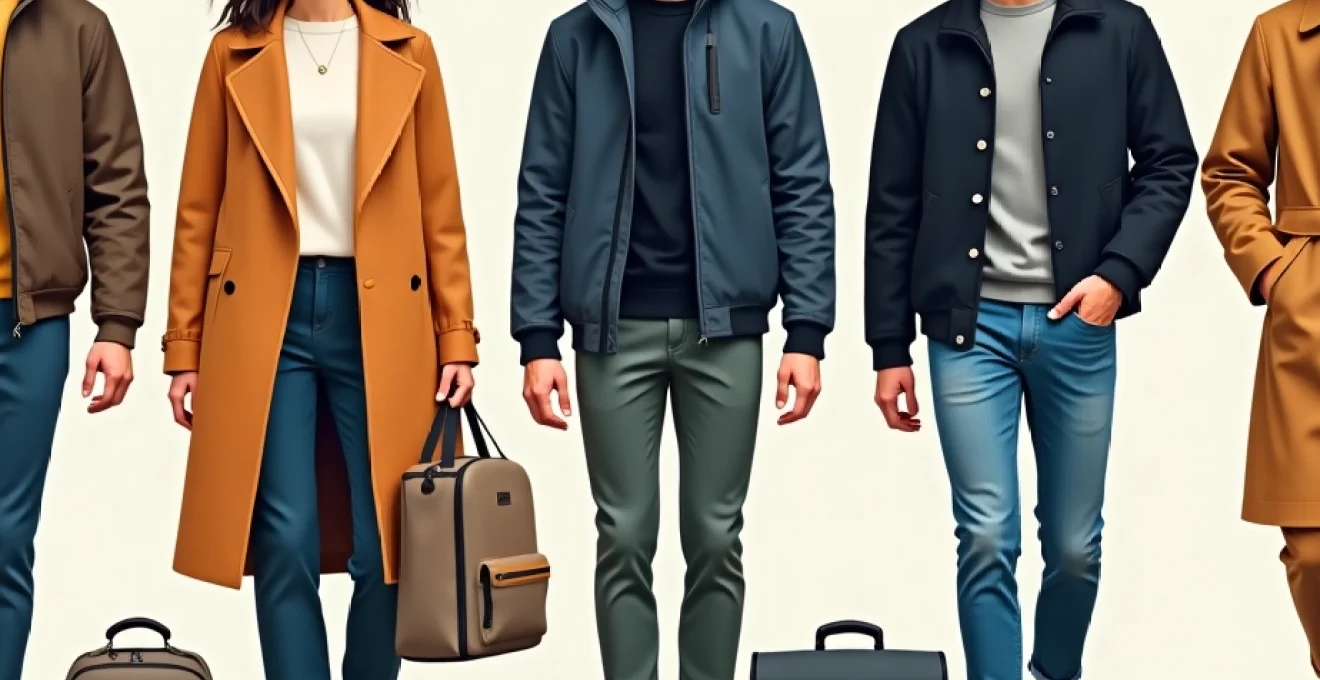
Modern travel demands a sophisticated approach to wardrobe curation that balances functionality with style. The days of choosing between looking good and feeling comfortable whilst exploring diverse destinations are long behind us. Today’s discerning travellers require garments that transition seamlessly from arctic conditions to tropical heat, from casual sightseeing to formal business meetings, all while maintaining their shape, colour, and professional appearance throughout extended journeys.
The art of travel wardrobe curation extends far beyond simple packing lists or colour coordination. It requires understanding fabric technologies, garment construction, and the mathematical principles behind creating maximum outfit combinations from minimal pieces. Whether you’re embarking on a week-long city break or a month-long multi-climate expedition, the strategic selection of high-performance travel pieces can transform your entire travel experience.
Multi-climate fabric technology: performance textiles for diverse destinations
The foundation of any successful travel wardrobe lies in understanding how different fabrics respond to varying environmental conditions. Traditional cotton and wool, whilst comfortable in controlled environments, often fail to deliver the consistent performance required for modern travel. Advanced fabric technologies have revolutionised the way garments regulate temperature, manage moisture, and maintain their appearance across diverse climatic conditions.
Performance textiles represent a significant advancement in travel clothing, offering properties that were previously impossible to achieve with natural fibres alone. These engineered fabrics combine the comfort of traditional materials with enhanced durability, stain resistance, and temperature regulation capabilities. Understanding these technologies empowers you to make informed decisions about which pieces will serve you best across different destinations and activities.
Merino wool base layers: temperature regulation from arctic norway to tropical thailand
Merino wool stands as the gold standard for travel base layers, offering unparalleled versatility across extreme temperature ranges. Unlike conventional wool, merino fibres are incredibly fine, typically measuring less than 24 microns in diameter, which eliminates the scratchy sensation associated with traditional woolens. This natural fibre possesses unique thermal properties that actively regulate body temperature, keeping you warm in cold conditions whilst providing cooling effects in warmer climates.
The moisture-wicking capabilities of merino wool surpass those of synthetic alternatives, absorbing up to 30% of its weight in moisture without feeling damp against the skin. This characteristic proves invaluable during long-haul flights, extended walking tours, or when transitioning between air-conditioned interiors and humid outdoor environments. Additionally, merino wool naturally resists odour-causing bacteria, allowing garments to be worn multiple times between washes without compromising freshness.
Leading manufacturers like Smartwool and Icebreaker have perfected merino wool blends that enhance durability whilst maintaining the fibre’s natural benefits. These garments serve equally well as standalone pieces in moderate climates or as foundational layers in more extreme conditions, making them essential components of any well-curated travel wardrobe.
Synthetic blend performance: patagonia capilene and arc’teryx phase integration
Synthetic performance fabrics offer distinct advantages over natural fibres in specific travel scenarios. Patagonia’s Capilene technology utilises recycled polyester blends that excel in high-activity situations where rapid moisture transfer is crucial. These fabrics dry significantly faster than natural alternatives, making them ideal for destinations with limited laundry facilities or unpredictable weather conditions.
Arc’teryx Phase series garments incorporate advanced synthetic constructions that prioritise breathability and temperature management. The brand’s proprietary fabric technologies create micro-climates that adapt to changing conditions throughout the day, whether you’re navigating crowded markets in humid conditions or ascending to higher altitudes where temperatures drop rapidly.
The integration of synthetic blends becomes particularly valuable for travellers who engage in diverse activities during single trips. These fabrics maintain their performance characteristics even when exposed to saltwater, chlorine, or frequent washing cycles, ensuring consistent functionality throughout extended journeys. Their quick-drying properties also make them practical for travellers who prefer to pack light and wash frequently.
Technical cotton alternatives: outlier supermarine and ministry of supply apollo
The evolution of cotton alternatives has produced fabrics that maintain the familiar feel of traditional cotton whilst incorporating advanced performance features. Outlier’s Supermarine cotton undergoes specialised treatments that enhance water resistance and durability without sacrificing breathability. These garments appear identical to conventional cotton pieces but offer superior stain resistance and longevity.
Ministry of Supply’s Apollo fabric technology represents another breakthrough in technical cotton alternatives. This engineered textile provides the professional appearance required for business travel whilst incorporating moisture-wicking and odour-resistant properties typically found only in athletic wear. The result is clothing that transitions seamlessly from boardroom presentations to casual exploration.
These technical cotton alternatives bridge the gap between performance and aesthetics, offering solutions for travellers who require professional appearance without compromising functionality. They maintain their shape and colour better than traditional cotton, requiring fewer replacements and reducing long-term travel wardrobe costs.
Quick-dry polyester composites: moisture management in humid climates
Polyester composite fabrics have evolved significantly beyond their early synthetic predecessors, now incorporating sophisticated weave structures and chemical treatments that enhance performance. Modern quick-dry polyester blends utilise capillary action to move moisture away from the skin rapidly, preventing the clammy sensation often associated with synthetic materials in humid conditions.
These fabrics excel in tropical destinations where high humidity and frequent precipitation create challenging conditions for traditional materials. Their ability to dry completely within hours makes them invaluable for travellers who encounter unexpected weather changes or engage in water-based activities. The latest polyester composites also incorporate anti-microbial treatments that prevent odour development, extending wear time between washes.
The durability of modern polyester composites surpasses that of natural fibres in many applications, maintaining colour vibrancy and structural integrity through hundreds of wash cycles. This longevity makes them particularly cost-effective for frequent travellers who require reliable performance from their clothing investments.
Capsule wardrobe architecture: mathematical approach to versatile combinations
Creating an effective travel capsule wardrobe requires understanding the mathematical relationships between garment combinations and practical outfit creation. The traditional approach of packing favourite items without considering their interaction often results in limited styling options and missed opportunities for creative combinations. Strategic wardrobe architecture maximises outfit possibilities whilst minimising packed items, creating exponential value from each selected piece.
The science behind capsule wardrobe creation involves analysing colour relationships, silhouette compatibility, and functional versatility across different social and environmental contexts. This systematic approach ensures that every packed item serves multiple purposes and integrates seamlessly with other wardrobe components. Understanding these principles transforms packing from guesswork into a precise methodology that delivers consistent results.
Five-by-five formula: creating 25 outfits from 10 strategic pieces
The five-by-five formula represents a mathematical approach to capsule wardrobe construction that maximises outfit combinations through strategic piece selection. This system involves choosing five tops and five bottoms that create twenty-five different combinations, with each piece carefully selected for its compatibility with multiple other items. The formula extends beyond simple mathematics to consider colour harmony, silhouette balance, and appropriate styling for various occasions.
Implementation of this formula requires careful analysis of each garment’s versatility quotient—the number of successful combinations it can create with other wardrobe pieces. High-performing items often feature neutral colours, classic silhouettes, and adaptable styling options that work across casual and formal contexts. The most effective capsule wardrobes include pieces that serve multiple functions, such as blazers that work as outerwear, layering pieces, or standalone tops.
The psychological benefits of the five-by-five system extend beyond practical considerations. Having pre-determined combinations eliminates decision fatigue whilst travelling, allowing you to focus energy on experiences rather than wardrobe choices. This approach also prevents the common travel mistake of overpacking “just in case” items that rarely see use during actual trips.
Colour palette engineering: neutral foundation with accent integration
Colour palette engineering forms the cornerstone of successful capsule wardrobe design, requiring understanding of colour theory principles and their practical application in limited-piece systems. The most effective travel palettes utilise a neutral foundation comprising 70-80% of wardrobe pieces, with carefully selected accent colours providing visual interest and personality expression. This distribution ensures maximum compatibility whilst preventing monotonous appearance.
Neutral foundations typically centre around one primary neutral colour—navy, black, or sophisticated grey—supplemented by secondary neutrals like white, cream, or khaki. These colours provide the backbone for reliable combinations whilst offering sufficient variety to create distinct looks. The selection of your primary neutral should consider your skin tone, personal style preferences, and the destinations you’ll be visiting.
Accent colour integration requires strategic thinking about placement and intensity. Vibrant accents work best in easily changeable pieces like scarves, accessories, or one statement top that can transform multiple neutral outfits. This approach allows personality expression without compromising the mathematical efficiency of your capsule system. The key lies in selecting accent colours that complement your chosen neutrals whilst adding sufficient contrast to create visual interest.
Layering systems design: modular approach to temperature adaptation
Effective layering systems function like modular building blocks, allowing precise temperature regulation through strategic addition or removal of garment layers. This approach proves essential for travel that spans multiple climate zones or involves significant temperature variations throughout single days. Professional layering system design considers the thermal properties of each layer, their compatibility when worn together, and their individual styling potential.
The foundation layer serves dual purposes: moisture management against the skin and standalone wear capability in appropriate conditions. Mid-layers provide primary insulation whilst maintaining breathability and packability. Outer layers protect against wind, precipitation, and temperature extremes whilst complementing the overall aesthetic of your wardrobe. Each layer must function independently and in combination with others.
Modern layering systems incorporate technical fabrics at each level to optimise performance. Base layers utilise moisture-wicking materials, mid-layers employ insulating technologies like synthetic fill or merino wool, and outer layers feature weather-resistant treatments. This technical approach ensures consistent comfort across varying conditions whilst maintaining the professional appearance required for diverse travel contexts.
Footwear consolidation strategy: Three-Shoe maximum for extended travel
Footwear represents the most space-consuming and weight-heavy component of any travel wardrobe, requiring careful strategic planning to balance functionality with packing efficiency. The three-shoe maximum strategy addresses this challenge by selecting footwear that serves multiple purposes whilst providing appropriate options for all anticipated activities. This approach prevents the common travel mistake of bringing specialised shoes for activities that may not occur.
The optimal three-shoe combination typically includes one pair of comfortable walking shoes suitable for extended exploration, one pair of versatile dress shoes appropriate for dining and social occasions, and one pair of activity-specific footwear tailored to your planned activities. The key lies in selecting shoes within each category that serve multiple functions without compromising performance in their primary roles.
Quality considerations become paramount when limiting footwear options, as each pair must withstand extended use across diverse conditions. Investment in well-constructed shoes with replaceable components, weather-resistant treatments, and proven comfort for extended wear pays dividends throughout multiple trips. The consolidation strategy also encourages selection of footwear in colours that complement your overall wardrobe palette.
Wrinkle-resistant garment selection: professional standards across time zones
Professional travel demands garments that maintain crisp, polished appearance despite being compressed in luggage, worn during long flights, and subjected to varying humidity levels across different destinations. Traditional fabrics often fail these tests, emerging from suitcases with creases that require professional pressing or time-consuming steaming. Modern wrinkle-resistant technologies have evolved to address these challenges, offering garments that spring back to their original shape with minimal intervention.
The science behind wrinkle resistance involves both fabric construction and chemical treatments that enhance fibre memory and resilience. Advanced weaving techniques create fabrics with inherent shape retention, whilst specialised finishes provide additional protection against creasing. These technologies have progressed significantly beyond the stiff, artificial feel of early wrinkle-resistant garments, now offering fabrics that feel natural whilst providing superior performance.
Understanding wrinkle-resistant technologies empowers you to make informed decisions about garment selection for business travel or occasions requiring professional presentation. The best wrinkle-resistant fabrics combine performance with natural hand feel, ensuring comfort throughout extended wear whilst maintaining the crisp appearance required for professional settings. These garments prove particularly valuable for packed itineraries that don’t allow time for garment care between engagements.
The evolution of wrinkle-resistant treatments has produced fabrics that withstand repeated packing and unpacking without losing their shape-retention properties. Modern treatments penetrate fibres at the molecular level, creating lasting performance that survives multiple wash cycles. This durability makes wrinkle-resistant garments particularly cost-effective for frequent business travellers who require consistent professional appearance.
Leading fabric technologies now offer wrinkle resistance that rivals traditional pressing, with garments recovering their original shape within minutes of unpacking, eliminating the need for hotel room ironing or professional pressing services in most situations.
The integration of wrinkle-resistant properties with other performance features has created multi-functional fabrics that address multiple travel challenges simultaneously. Modern business travel garments often combine wrinkle resistance with moisture-wicking, odour control, and stain resistance, creating comprehensive solutions for professional travellers. These integrated technologies ensure consistent performance across diverse travel conditions whilst maintaining the sophisticated appearance required for business contexts.
Weight-to-versatility ratio: technical analysis of High-Performance travel pieces
The weight-to-versatility ratio represents a crucial metric for evaluating travel garment efficiency, measuring the functional value delivered per gram of packed weight. This analytical approach proves essential for travellers operating under strict weight limitations or those prioritising mobility and ease of movement. Understanding this ratio enables strategic decisions about which pieces deserve space in limited luggage capacity versus those that should remain at home.
High-performance travel pieces achieve superior weight-to-versatility ratios through advanced construction techniques and material selection. Ultra-lightweight fabrics maintaining durability and appearance standards offer exceptional efficiency, as do garments designed to serve multiple functions within single pieces. The most effective items often feature removable components, convertible designs, or styling flexibility that adapts to various contexts without additional weight penalty.
Modern textile engineering has produced fabrics with remarkable strength-to-weight characteristics, utilising advanced synthetic fibres and innovative weave structures to create garments that feel substantial whilst weighing significantly less than traditional alternatives. These technologies prove particularly valuable for adventure travel or extended journeys where every gram counts towards overall packing efficiency and physical comfort during transport.
The assessment of weight-to-versatility ratios should consider both quantitative measurements and qualitative performance factors. Quantitative analysis involves calculating cost per wear, weight per styling option, and durability per invested gram. Qualitative factors include comfort during extended wear, appropriateness across diverse social contexts, and psychological confidence provided by well-fitting, attractive garments. The most successful travel pieces excel in both categories.
Professional evaluation of travel garments reveals significant variation in weight-to-versatility ratios across different brands and construction methods. Premium travel clothing often justifies higher initial costs through superior ratios, delivering more functional value per gram whilst lasting longer and maintaining appearance better than budget alternatives. This analysis supports investment in high-quality pieces that serve multiple trips rather than frequent replacement of less efficient options.
The most efficient travel garments achieve weight-to-versatility ratios that exceed 10:1, meaning each 100-gram piece can create more than 10 distinct styling combinations whilst maintaining professional appearance standards across diverse travel contexts.
Technology integration has enhanced weight-to-versatility ratios through features like packable designs that compress to minimal space when not worn, reversible construction that provides two styling options within single pieces, and modular components that reconfigure for different functions. These innovations demonstrate how thoughtful design can multiply garment functionality without proportional weight increases.
Climate adaptability represents another crucial factor in weight-to-versatility calculations, with the most efficient pieces functioning across wide temperature ranges through intelligent layering compatibility or inherent thermal regulation properties. Garments that require additional pieces to function in different climates score lower on efficiency metrics than those adapting independently to varying conditions. This consideration proves particularly important for multi-destination travel spanning diverse climate zones.
Specialised travel accessories: technical gear integration and space optimisation
Travel accessories extend far beyond simple aesthetic enhancement, serving crucial functional roles in modern travel wardrobes whilst contributing to overall packing efficiency. The most effective travel accessories provide multiple functions within compact, lightweight designs that complement your clothing selections whilst solving common travel challenges. Strategic accessory selection can transform basic wardrobe pieces into sophisticated ensembles suitable for diverse occasions and environments.
Space optimisation through accessory selection requires understanding how different items can serve overlapping functions without redundancy. Multi-functional accessories that combine practical utility with style enhancement offer superior value proposition compared to single-purpose items. The key lies in
identifying accessories that can be worn in multiple ways, packed efficiently, and maintained easily during travel. Technical integration involves selecting accessories that work seamlessly with your clothing whilst providing practical benefits like organisation, weather protection, or security enhancement.
Modern travel accessories incorporate advanced materials and thoughtful design elements that maximise utility whilst minimising packed volume. Compression technologies allow bulky accessories to pack small, expandable designs accommodate varying needs, and modular systems provide customisation options for different travel scenarios. These innovations have transformed accessories from luxury additions to essential travel tools that enhance both functionality and style.
The integration of technical features into traditional accessories has created hybrid products that serve multiple purposes without aesthetic compromise. Smart fabrics in scarves provide warmth regulation, bags incorporate RFID blocking materials for security, and jewellery designs accommodate practical storage needs. This evolution reflects the modern traveller’s demand for products that perform beyond their traditional roles whilst maintaining sophisticated appearance standards.
Strategic accessory curation requires evaluating each item’s contribution to your overall travel efficiency and style objectives. The most valuable accessories enhance multiple outfits, solve specific travel challenges, and pack compactly when not in use. This approach prevents accessory accumulation that adds weight without proportional benefit, ensuring every packed item earns its space through demonstrated utility and aesthetic contribution.
Premium travel accessories now achieve functionality densities exceeding 5 uses per 100 grams, combining style enhancement with practical problem-solving capabilities that justify their inclusion in weight-conscious travel wardrobes.
Quality considerations for travel accessories mirror those for garments, emphasising durability, maintenance ease, and consistent performance across diverse conditions. Investment in well-constructed accessories pays dividends through extended service life and reliable functionality during crucial travel moments. The best travel accessories maintain their appearance and performance characteristics despite repeated packing, diverse climate exposure, and frequent handling during transit.
The psychology of accessory selection influences both personal confidence and social perception during travel interactions. Well-chosen accessories can elevate simple garment combinations to sophisticated presentations appropriate for upscale dining, business meetings, or cultural events. This transformation capability makes strategic accessory investment particularly valuable for travellers who encounter diverse social contexts during single trips, allowing wardrobe adaptability without extensive garment variety.
Storage and organisation solutions for travel accessories have evolved to address the challenge of maintaining accessibility whilst preventing damage or loss. Dedicated accessory organisers utilise compartmentalised designs that protect delicate items whilst maintaining visual inventory of packed accessories. These systems prevent the common travel frustration of searching through luggage for specific accessories whilst ensuring items remain in pristine condition throughout journeys.
The environmental impact of accessory choices increasingly influences purchasing decisions for conscious travellers. Sustainable materials, ethical production methods, and longevity considerations contribute to accessory evaluation beyond immediate functional benefits. Accessories produced from recycled materials or designed for exceptional durability align with responsible travel practices whilst often delivering superior performance characteristics compared to conventional alternatives.
Integration timing for accessories requires understanding when and how different pieces enhance outfit combinations throughout travel itineraries. Morning accessories might prioritise functionality and weather protection, whilst evening selections emphasise style enhancement and social appropriateness. This temporal approach to accessory integration ensures optimal utility from limited pieces whilst maintaining appropriate presentation standards across diverse daily contexts during travel.